Basic Theology

What Is Faith? (Part One: Faith is a Substance)

Standard

“Now faith is the substance of things hoped for, the evidence of realities not seen.” (Heb. 11:1 TLV, emphasis mine)

Faith is a special kind of belief. We can believe something and be completely wrong or misguided. But faith is a belief based on tangible spiritual evidence that is directly rooted within a relationship with God. Through an intimate knowledge of God, faith provides vision into God’s supernatural Kingdom; and this is why it can be so powerful when used rightly.

Faith perceives through spiritual senses what cannot be accounted for in the physical. Faith recognizes what the Spirit of the Lord is doing even before it manifests into reality. Faith is an inside connection to the Kingdom of God, developed through learning God’s voice.

Faith says, Even though my reality is otherwise, I have a peaceful assurance beyond all doubt, and a proof in my spirit that this is the truth.

When the “things hoped for” are physically out of reach or inconceivable, faith is the steady foundation of clarity and courage that brings stability and perspective to the whole situation. It is a substantial force, regardless of how invisible or unfathomed by those outside of it. And faith is not necessarily illogical. We all connect to the world differently, and have a different array of dominant spiritual senses; so while one person may gain faith through an emotional experience, another may receive faith through a more physical, or even intellectual, experience.

The common element in how the substance of faith is received is dependent on one’s relationship with God: “So then faith comes by hearing, and hearing by the word of God.” (Rom. 10:17 NKJV)

Do you want more faith? Do you want to see what the Lord is doing in the invisible realm, and to have peace or wisdom regarding your situation? The best place to start is by reading the Bible, and dialoging with the Lord (the Living Word) through prayer. The marriage of the Spirit and the Word together in our lives builds a framework of faith that will usher us into the Kingdom—and the Kingdom into our physical realities.


Unexpected Goodness

Standard

I love to cook, and I happen to be vegan. Just as with any food there are awesome vegan dishes and barely edible ones.

I was talking to a new friend who learned I was vegan and said, “Oh, I had a vegan cookie once and it was awful.” I had to chuckle, because, yes, I have had bad vegan cookies too. It happens. I love to experiment in the kitchen, with a large variety of results. A couple days ago I made a flourless cake using sweet potato, coconut, and ground nuts, I was surprised how well it turned out! It was good! I could have easily missed out had I not been so bold with putting ingredients together in a new way.

When we set “good” to equal something very specific, our expectations can limit us from experiencing other good things.

When my husband and I first got together, he was convinced he didn’t like lentils because he hated the lentil soup his mom would make. Lo and behold, he loves the spicy lentil dishes I am drawn to preparing, and he shortly realized that it was not the lentils themselves he didn’t like, but the particular lentil dish.

Sometimes we have to adjust our expectations, learn to be flexible, and exercise our creativity because life always comes with unexpected twists. If I let my expectations for my life limit or define my joy, I could miss out on what God has planned for me in a season of unanticipated experiences. The feeling of missing out on a particular form of “goodness” would come due to the mistake of looking for something else—from expecting goodness, or healing, or friendships, or opportunities, to come in a particular way.

For example, I have experienced healing miracles where God has done an instant miraculous work, and others where He has given me a physical strategy (like changing my diet) in order to lead to healing. I have also been walking through a season of chronic autoimmune issues, knowing full well that He is the healer, but finally feeling the flexibility and security of finding goodness in His person rather than needing or expecting it in my immediate circumstances. It took me awhile to recognize that my expectations for healing were hindering me from fully enjoying the presence of God, which is in itself more valuable than any physical experience—even of healing. I have been finding freedom by focusing first on God’s goodness—finding joy in worshipping Him, rather than in my experiences (in myself).

But seek first His kingdom and His righteousness, and all these things will be added to you” (Mat. 6:33).

God is good. But God is also the ultimate Creator. His ways are not always our ways. He puts things together in an unusually creative fashion. But in His wisdom He knows what He is doing. We can trust that eventually everything is working together to become something GOOD.

What was Job's deepest wound?

Standard

If I were Job, and I lost my family, home, and animals I would not think that eventually receiving more would replace what was lost. No no child can replace a deceased child. No household pet can replace a lost pet. And—while I am not the sentimental type—there is value in the memories that places, people, and possessions can spark in our lives.

dinosaurI was pondering this when I realized I was not properly recalling the setting of Job’s story. Job seems to be as close to “cave man” as the Bible exposes. It appears he was living with dinosaurs and fire-breathing dragons (Job 40-41); and so maybe losing family members and other beloved possessions was not so uncommon. When things are common, they might still be terrible, but the expectation is different; our responses are different.

Perhaps Job’s story is not so much about the loss of irreplaceables as it is about 1) every bad thing happening at once (i.e. way more than he can handle without the Spirit), and 2) the common expectation that good things happen to godly people, and that God is working everything out for His good—specifically in bringing retribution and carrying out judgement. (Theologians call this last thing the Retribution Principle: it’s the biblical version of “karma” except that it only really works from an eternal perspective.)

It would certainly have been difficult—even beyond difficult—for Job to endure so much. But I think his deepest grief came from the failure of his expectations in God. He heard God, and dialoged with God—God is ever-present with him. Yet God delays in intervening. And God allowed it all to happen. There had been a “hedge of protection” around Job (an angelic protection? a spiritual ‘bubble’? a season of blessing?) and God took it away (Job 1:10).

Job learns to trust God and let God set the expectations for his life. He cannot hold onto both his own expectation for his life to turn around and his full dependence on God at the same time (even though he was correct in believing that God wanted to bless him and that he did not deserve his circumstances). Sometimes we have to release God to heal our circumstances by accepting them, and worshiping God anyway. I am doing this in a couple areas of my own life. My husband calls it, “realistic optimism”: accepting that if things do not change it will be okay, while continuing to have hope and flexibility in actively anticipating God’s promises coming to pass—whatever the timing, and however it looks.

And that part about Job enduring way more than he could handle? Maybe God wanted Job to recognize that alone he could not handle much, but through the Holy Spirit he could pass through it all, so that nothing is impossible (Luke 1:37). He who can endure all things allows us to endure all things through Him—love is the key to this (1 Cor. 13:7: “love endures all things”). When Job is full of God’s love, he prays for his friends, and they too are redeemed. We, too, can choose to embrace God’s love in the anticipation that He knows what He is doing, and He will see us through. It is a joy through the release of our own expectations.

My Seminary Adventures and The Incarnation

Standard

I am currently taking three seminary courses: Biblical Archaeology, Christian Theology II (Christology (the study of Christ), Soteriology (Salvation), and Pnuematology (Holy Spirit)), and Pastoral Counseling. It has been a lot of work, and while quite rewarding, I have also been pretty tired. We cover so much territory so quickly that I have wondered what to share that wouldn’t involve creating a context first, and I’ve decided to share about the incarnation.

The incarnation refers to Jesus becoming human. John 1 says that the Word who existed from the beginning, who both was God, and was with God, became flesh. So Jesus who is fully God, the living Word, became en-fleshed (incarnated) into a human body, thus becoming fully human. It is a great paradox that Jesus is wholly God and wholly man, but this is what happened. Jesus is the Son of God, and Jesus is the Son of Man. Only as wholly God and wholly man could He bring reconciliation and mediation between these worlds that should never have had such a chasm between them. There is so much to say regarding these two natures of Jesus that exist in His one person, but I will highlight just a few:

Most striking to me is that as the Son of Man Jesus represents THE man—He represents what all humanity should look like when filled with the life of God (the Spirit of God). We think of ourselves as humanity, and come up with sometimes negative conclusions about our human state. But as Jesus demonstrates, it is not being human that is the problem, but the illness (sinfulness) that has crept into every aspect of humanity and transformed our “normal”. Jesus comes with freedom, and lives as God intended for all humanity. Comparatively, we cannot possibly match Him, yet God created us (and is recreating us) to live like Christ. This is truly incredible.

Also, as the Son of Man, Jesus is able to fully relate to us, and this is another aspect that is so amazing yet so hard to fully grasp. He knows us as God, but He also KNOWS us as a fellow man. I have frequently heard it mentioned that Jesus understands our sin and pain, having born these on the cross, but there is so much more than that. He also simply understands what it feels like to be human and to have limits—the joys of humanity, the temptations, the sorrows—He knows and has experienced all of it. It is incomprehensible.

Jesus is no less amazing as the Son of God. Jesus is uniquely the Son of God—we are adopted sons and daughters of Christ (able to receive the inheritance and lifestyle that comes along with that sonship), but He alone is THE Son of God. He alone was born of God. We (Christians) were re-born of God (and those who have not experienced this are invited to receive His salvation as He died for the sins of the whole world)—but we are only adopted siblings of Jesus, since we are birthed by humanity. This differentiation brings a new level of exaltation to Christ, and it also has ramifications for us in understanding God’s love. How awesome is it that we would be considered a fellow inheritor of the Kingdom, as if we were born of God ourselves!?!

The last I will mention is how awesome it is that Jesus, the Son of God, has become our salvation. His name is Yeshua (salvation); and indeed, He is the living embodiment of salvation in every way. If He were only the Son of Man, as Jews expect of HaMashiach (the Messiah), then He could have conquered and brought healing to the physical realm only. Instead He is the thread that can mend the gap between the heavens and the earth. He brings full restoration both spiritually and physically—it is a “now” and “not yet” promise, and I am so excited for the completion of this reconciliation.

All Brains on Board: Thoughts on the Bill Nye, Ken Ham Debate

Standard

The not-so-epic Evolution/Creation debate between Bill Nye the Science Guy and Ken Ham took place this past Tuesday, and I am still thinking about it. I admit, I am relieved I did not spread the word before hand for my family and friends to watch it, because it wasn’t a great day for demonstrating that Christian Creationists can be intelligent, science-based thinkers.

The original debate question was regarding whether or not Creationism is a viable model of origins in today’s modern scientific era. As I watched the debate live on Tuesday I was disappointed that Ken Ham centered his argument on theology (i.e. that Creationism is viable because the Bible says it is) more than on the evidence of the question at hand. As I watched parts of the debate again today I realized that while Bill Nye’s purpose was to prove the underlying ignorance of Creationism as per the question, Ken Ham was more interested in demonstrating (proselytizing?) the gospel message—assuming that the debate audience will (or at least should) consider the Bible first, and the evidence second. Ken Ham was successful, I think, at his aim (presenting his biblically based worldview); but I am disappointed he did not engage the atheist/agnostic/humanist portion of the audience by sticking to the tangible foundation of science that is common to both perspectives.

I happen to be a literal-day, young earth Creationist, but beyond this I believe that truth is an absolute, which can be discovered and observed to all who look for it regardless of whether or not the inquirer has a Bible on hand. In other words, science should have room for Creationism (really, Intelligent Design) without any reliance on the Bible, and I honestly believe it does. In fact, I personally became a Creationist first, and a follower in Jesus about five years later; so, for me, understanding the validity of Creationism as a viable alternative to Evolution helped me to believe the authenticity of Scripture, which later led to me recognizing God when I encountered Him.

I read once that Christians tend to teach their children answers to questions while Jews tend to teach how to ask good questions and debate. I do not know how representative this is, but I do know that the problem is not with holding a particular worldview (Creationism/Intelligent Design/Evolution, or Traditional Medicine/Alternative Healthcare/Folk Healthcare Practices, and so on), but in making faulty assumptions, and in failing to continually ask good questions (“Why are we seeing this?” “Why aren’t we seeing that?” “Do I have a solid basis for believing __?”).

Moreover, Bill Nye wants and expects for truth to always be reasonable. I would argue that it often is not. Some things do not make sense. The supernatural realm adds another layer of complication to “reasonable”—and I say this as a rational person who has experienced many things I cannot describe (like food multiplication miracles, instant healing miracles, prophecy, and some really wild things that sound too unbelievable to list).

But back to the question at hand… Let’s say hypothetically that Creationism (in any form) is incorrect. Could a mislead Creationist still viably add something to the scientific model in today’s world? I would argue that if the Creationist was a creative and thinking person, asking good questions, and attempting to predict the future based on observable patterns that absolutely that person could add something significant. The job of the defense (of a guilty person) is to keep the prosecution on their game. Any thinker knows that it is engaging those with a difference in perspective on life that refines and strengthens our own case, not the opposite. It is for this reason that I often play devil’s advocate within my own studies and theological research in attempt to find weaknesses in my own case—and often I have changed my entire perspective because I’ve found myself so convincing. :-)

It seems a mistake to me that we would limit science (or theology, or health/medicine, etc.) to only familiar paradigms by calling all other (potentially obscure) perspectives nonviable. This is not critical thinking. Instead we should ask, “How can we teach young people to truly think critically? How do we teach them, not what to believe, but how to think and discover solutions?” A bit of creativity, a bit of non-sequential thinking is necessary to break out of the realm of what we know and into deeper places of observation and discovery.

Daniel learned all the knowledge of the Babylonians and also received the wisdom of God. I, likewise, plan to teach my kids how to truly think by providing them with the knowledge of the world, the wisdom of the historical church, and the ability to think, hypothesize, and observe in both the tangible realm of intellect, and the abstract and supernatural realms of the other worldly.

Let us encourage every brain to truly think.

Drawing in the Sand

Standard

In the past when I have considered the story of Jesus defending the adulterous woman in John 8, I have wondered, “What was He writing in the dirt?” Today as I was doing my normal household work, I recalled this story with a new focal point: He was writing. The what does not matter so much as the action itself.

It is interesting to me that Jesus does not inquire about this woman’s past or present circumstances. She had been caught in the act of adultery—an especially big deal for her setting, which insinuates all is not well with this woman without defining whether the problem is within herself or brought on by an external force (e.g. in the matter of sexual abuse). Beyond her punishable actions, she likely has emotional hurts, needs, and a life reflecting those areas of brokenness. As God, Jesus would have known these things; as man, His knowledge of her circumstances may have been limited. Either way, it appears He chooses to see her future rather than her past.

There is a parallel here to the story of creation: man being formed from the dust compared to Jesus writing in the dust. Writing is an act of creation. It is the release of a word. In the beginning God created by releasing His word (and BTW the word for spirit/Spirit is the same as the word for breath in both Hebrew and Greek, so the process of speaking words is also a release of His Spirit). Jesus now re-creates this woman’s life in a similar manner. He draws/writes in the dirt His word regarding the situation, or perhaps about her, or perhaps about Him. And through this His Spirit is also released: a spirit who desires creation, re-creation, reconciliation, and love beyond any other thing.

Jesus’ judgment for this situation—His ruling—overlooks the problem of the past/present in order to present a vision of the future. The further surprise is that although Jesus is without sin, He too is not willing to stone this women. He says, “Neither do I . Go and sin no more” (verse 11). It is natural that the sinful religious authorities be denied the right to stone her for her sins; but Jesus, having true authority and the prerogative to carry out retribution, chooses re-creation instead of extermination.

If judgment is defined as making wrong things right, His judgment is against the accusations and religious traps of these particular religious leaders and for the restoration of this woman’s full being (her internal feelings, and her external actions). Love propels this restoration; accusation solidifies the problem and hinders positive growth. Love carries the authority to say, “Go. Be renewed,” because it provides a vision for that future renewal.

Evidence of the Baptism in the Holy Spirit in Acts

Standard

What happens when the Holy Spirit comes upon someone? I shared earlier about my own experience with the baptism in the Holy Spirit, including the initial evidences in my own life. Now, I’d like to simply list some of the accounts in the book of Acts where believers were baptized in the Holy Spirit, along with the physical evidence that the Spirit-filled believers manifested at this time:

Acts 2: Devout Jews and proselytes from every nation had gathered in Jerusalem to celebrate Shavuot, when the Holy Spirit came upon them and filled them. They each heard the gospel in their own languages and many received salvation through Jesus. Then, Peter explained to the crowd what was happening, because this was the first time the Holy Spirit was poured out corporately in this way.

What happened when the Spirit came upon them:

  • The Holy Spirit was heard/felt as a violent rushing wind (Acts 2:2)
  • There appeared to them tongues as of fire distributing themselves, and the fire rested on each one of them (Acts 2:3)
  • They began to speak in other tongues as the Spirit gave them utterance--most likely other human languages (Acts 2:4-11)
  • They acted as if they were drunk (Acts 2:13-16)
  • Peter connected the event as a partial fulfillment to Joel 2, which prophesies that both men and women, both young and old, both slaves and free-men, will have dreams, visions, and prophesies from God when they receive the Holy Spirit (Acts 2:17-21)
  • The effects of the Holy Spirit were both seen and heard (Acts 3:33)
  • Everyone felt a sense of awe (Acts 3:43)
  • Signs and wonders were taking place (Acts 3:43)
  • The people had one mind and became a unified community, even sharing their possessions with each other, eating together, and praising God together (Acts 3:37-47)
Acts 4: A group of believers, including Peter and John, is arrested for teaching the people and proclaiming in Jesus the resurrection from the dead.

How did the Holy Spirit evidence Himself:

  • Peter and John--uneducated and untrained men--spoke with clarity and boldness (Acts 4:8-13)
  • They had earlier healed a man, and it was recognized as a noteworthy miracle (Acts 3:1-10; Acts 4:14-16)
  • They had unprecedented boldness and were unable to stop speaking about what they had seen and heard (Acts 4:20, 31, 33)
  • They were unified as one body, sharing everything (Acts 4:32-37)
Acts 7:54-60: Stephen is stoned to death while full of the Holy Spirit.

How did the Holy Spirit evidence Himself:

  • Stephen was able to gaze into heaven and see the glory of God and Jesus standing at the right hand of God
  • He was given the power to forgive them as they were violently killing him
Acts 9: Saul's conversion: Jesus appeared to Saul and spoke audibly to him (so that even the men with him could hear). The experience left Saul blind. Then, Ananias was led by God to visit Saul (a big deal, since Saul persecuted Jewish believers like Ananias). When Ananias laid hands on Saul and prophesied over him, he was filled with the Spirit.

What happened when the Spirit came upon him:

  • Saul received spiritual wisdom (the scales fell off his eyes)
  • His physical blindness was healed
  • He became a completely different person: not only did he stop persecuting the Jewish believers, he began to proclaim Jesus openly in the synagogues
Acts 10:34-48: As Peter was preaching, the Holy Spirit fell upon those who were listening.

What happened when the Holy Spirit came upon them:

  • Both Jews and gentiles received the Spirit (Acts 10:45)
  • They spoke in tongues and exalted God (Acts 10:46)
  • In this case, the baptism in the Holy Spirit came before the baptism in water (Acts 10:47-48)
Of course, this isn't a complete list; the book of Acts is long, and (being that it focuses on the "Acts of the Apostles") includes multiple records of signs, wonders, and miracles that I neglected to mention. It is also interesting to note that although the Holy Spirit was available in the Old Testament, this was the first time that the Holy Spirit was available in fullness (not that we receive in fullness, but that He was fully given by God). Earlier I had mentioned Shavuot--rather than the Greek, Pentecost--because it is worthwhile to understand the parallel between the giving of the Holy Spirit and the giving of the Torah to Moses. Just as the Torah was fully given to Moses, but gradually and continually understood, so is the Holy Spirit fully available but gradually and continually absorbed. This is why the baptism of the Holy Spirit is so important--not just as a one time event, but continually as we walk with God.

I also want to note that, although the followers of Jesus were completely devoted to Him while He was on earth (and baptized in water by John), it was not until they received the gift of the Holy Spirit that they were able to connect with Jesus intimately from His place in heaven, and to effectively begin their ministries. In fact, I don’t think they even understood their ministries until they were filled with the Holy Spirit—after all, right before Jesus ascended, they asked if it was the time for the restoration of Israel. They were focused on themselves, and their nation, but the “great commission” was and is for the whole world. Without the fullness of the Holy Spirit it is impossible to fulfill the great plans of the Lord.

My Personal Experience with the Baptism in the Holy Spirit

Standard

Someone emailed me recently, asking what I meant on the “About Me” page when I mentioned I was baptized in the Holy Spirit. I really can’t believe I haven’t blogged about this already, since there is so much to say on the topic. I’m going to post a few entries about this, trying to keep each one concise enough to be comprehensible; I’ll begin with my personal experience and move on shortly to the more important theological and biblical contexts.

I was first introduced to the idea of the baptism in the Holy Spirit in college. I had joined a campus ministry that happened to be under the Assemblies of God denomination, which is somewhat charismatic. Although I was incapable at that point of comprehending much of anything theological (because of my deep involvement in the occult and inhabiting demonic spirits), I do remember some of my Christian friends engaging in a long argument about the baptism in the Holy Spirit and, as they put it, the “initial evidence of speaking in tongues”. Not everyone in the campus fellowship came from an AG background (most, probably, did not); and it quickly became a big discussion, with both sides using scripture to defend their positions. I did not know what was going on, but I knew I wanted more of God, so I started praying that I, too, would speak in tongues. It didn’t happen, and eventually other prayers—for survival and basic needs—took priority.

Some years later, I had reached my “bottom”. It was our first year of marriage, and I was so troubled that my problems were affecting both of us. I was seeing a psychologist and psychiatrist and taking tons of medication for my various psychological diagnoses, with little positive effect. Through God’s divine providence, I was given the opportunity to meet with a deliverance minister. (Deliverance ministers are like specialized counselors: they do everything from “normal” God-centered counseling and reconciliation, to helping people connect with and hear God personally, helping people understand and renounce the lies that they have believed, to the more extreme cases of casting out demons.) My first meeting with the deliverance minister, he asked if I had been baptized in water and received Jesus as my savior. I affirmed that I had. Then he asked if I had been baptized in the Holy Spirit. I didn’t understand his question.

The minister explained to me on real simple terms the basics about the Holy Spirit, the importance of building a relationship with Him, and the “baptism in the Holy Spirit” that John the Baptist indicates as a separate experience from water baptism (Mark 1:7-8, Luke 3:16, John 1:31-34), and which is extended on in other places in the New Testament (especially: Acts 8:12-17, Acts 10:44-48, Acts 19:1-7) . Something like that… Honestly, I don’t remember much of what he said.

I decided to welcome the Holy Spirit into my life. But, as soon as I began to ask Him, I was overcome with fear, and wasn’t sure I wanted my life to change. I was still inhabited by multiple demons at this point, so it was a really intense moment and decision. My vision became completely red for a moment, and I was paralyzed with a fear that prevented me from calling on God. The pastor could see that something was going on and asked me what I was feeling. He told me I needed to be absolutely sure that I wanted more of God, because I would have to give up everything.

After a moment of thought, I was sure of my decision. I asked the Holy Spirit very simply and sincerely to come into my life, and He answered my prayer. I immediately fell over. It felt like slow motion—not that anyone was pushing me over (no one was touching me)—but that I could not stand up in the presence of such a mighty God. I felt His presence fall on my head, and travel through my body. I saw a translucent gold water rush through my insides; it stayed in my vision for some time. (Later, as I read the gospel of John, I read that the Holy Spirit is living water, and recalled my experience—I can’t think of a better way to describe this except that living water had rushed into me.) I also felt pure joy, and began to laugh uncontrollably as the joy continued to surround me. It was the first time I had felt freedom.

I did not begin to speak in tongues that day. (I do now, and will share that experience upon request.) It also took three months for the inhabiting demons to be cast out—not that it couldn’t have happened instantly, but that by dealing with it slowly, I was able to close the spiritual doors that should never have been opened, and to gain more understanding of the spiritual realm.

Here is what did happen right away:

  • I received the fruit of the Spirit: most notably, peace and joy
  • For the first time, I became absolutely confident of my salvation
  • I became free from the bondage of sin (if and when I sin now, it is completely my own decision and rebellion)
  • I was given a desire to read the Bible, especially the gospels and New Testament, which had never interested me in the past
  • I became able to understand the scriptures (not completely, of course, but in a way that had not been possible before)
  • I became able to hear from God and recognize His voice (not that He hadn't already been speaking to me, but that my relationship with Him quickly developed into a two-way friendship)
  • The Holy Spirit became my helper, my teacher, my comforter, and my friend--I could not have made it through the rest of my deliverance (or life thus far) without Him
There are so many ways that the baptism in the Holy Spirit comes about--sometimes in monumental experiences, and sometimes much more subtly. The initial evidences of this experience are also varied. I have been involved with a variety of churches, and have noticed that some Christians do not believe in a separate baptism of the Holy Spirit, and yet have experienced it unintentionally by sincerely pursuing God. Stay tuned: next time I'll address the biblical context of the baptism in the Holy Spirit.


Jesus the Terrible Salesman

Standard

Recently I’ve begun a hobby in sales, which has caused me to see salespeople in a new way and to consider my own sales process. I’ve also been noticing that Jesus was a TERRIBLE salesperson. Rather, He wasn’t a salesperson at all! He wouldn’t let His disciples say goodbye to their families (Luke 9:59-62), He demanded His followers give up everything they had (Luke 14:25-27, Mat 19:20-21), He spoke in parables so that only the ones who wanted to understand would hear His message (Mark 4:9-12), He ministered to people with great miracles and then told them not to tell anyone (Mat 8:2-4), He at one point confronted His disciples and told them not to follow Him anymore if they didn’t want to (John 6:60-71), and He promised them persecution (Luke 21:12, John 15:20). If “selling” Himself and His gospel was the goal, these weren’t the best techniques.

Jesus could have created a large following, changed the government, declared Himself King, stayed alive, and lived a happy human life. But it wasn’t His mission. He wanted to change the whole whole by conquering sin and death and salvaging humanity from the chains of the devil. He wanted to save the people then AND the people yet to be born (us); and He wanted to rescue us both from the pain of sin now AND from the pain of Hades that was due to us. He spent His life on us, so that we might have eternal life through Him. Later, He will come back to declare Himself King, change the government, win the war, and enjoy life with us—the earth will be baptized in fire and the heavens will open. It won’t be good news for everyone, but we get to decide carefully whether to on Jesus’ team or against Him.

I love that God does not infringe on our free will. We can make whatever choice we decide is best for us (to accept Him, or maybe not to), and He wants us to fully consider our spiritual choices. Jesus said:

"If anyone comes to Me, and does not hate his own father and mother and wife and children and brothers and sisters, yes, and even his own life, he cannot be My disciple. Whoever does not carry his own cross and come after Me cannot be My disciple. For which one of you, when he wants to build a tower, does not first sit down and calculate the cost to see if he has enough to complete it? Otherwise, when he has laid a foundation and is not able to finish, all who observe it begin to ridicule him, saying, 'This man began to build and was not able to finish.' Or what king, when he sets out to meet another king in battle, will not first sit down and consider whether he is strong enough with ten thousand men to encounter the one coming against him with twenty thousand? Or else, while the other is still far away, he sends a delegation and asks for terms of peace. So then, none of you can be My disciple who does not give up all his own possessions." (Luke 14:26-33)

Here in California there are many building developments that halted when the economy dropped that will likely never be finished. And I can think of at least one "king" who started a war he couldn't finish. But Jesus says, don't be stupid like that. Consider following Me. If you believe I'm the Messiah, that I died on your behalf, that I rose again and am still alive in heaven waiting for the harvest of My people to be ripe so I can return to remove evil from the earth--if you believe I am who I say I am and that I'm worth it: give up everything and follow Me.

Jesus didn’t come to trick and manipulate people. He’s not a conniving cult leader. And yet a portion of the Jews believed Him, began to spread the gospel and started this thing we call Christianity. If you aren’t a follower of Jesus, you should carefully consider whether He is worth following. And if you love Jesus like I do, let me remind and encourage you that it’s not our job to convince anyone of anything—just to allow the Holy Spirit to work in us, and to share the good news of the gospel in a way that allows everyone the chance to consider if Jesus is Lord.

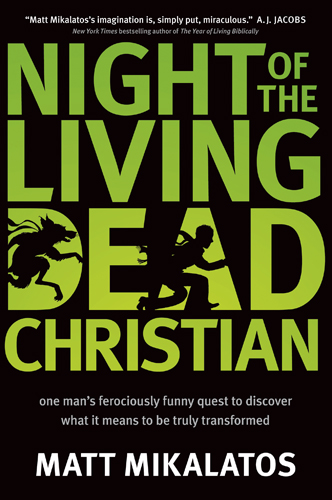
Review of Night of the Living Dead Christian by Matt Mikalatos

Standard

Genre: Allegorical Fiction/Satire/Spiritual Growth

Highly Recommended!

I’m not sure how to describe Night of the Living Dead Christian except that it’s full-on satire, very unique, and very good. Mikalatos mixes elements of fiction and non-fiction, and even includes himself as a character within the story. The story follows lycanthropic (werewolf) Luther Ann Martin as he discovers what it means to be a Christian and how to become free of his animalistic tendencies. Vampires, mad scientists, an android and a congregation of zombies are also woven into the narrative.

Each of the monsters or monstrous conditions represent various problems or tendencies within human nature, and through this, Mikalatos demonstrates the process of salvation and reveals much about the state of the church. There is a congregation of zombies, for instance, that do not think for themselves and act just like their leader. They run around proselytizing, stuffing headphones of podcasts into their victim’s ears, and trying to eat their victim’s brains. I’ve met this sort of creature; perhaps you have too.

Sometimes it takes imagining the world in fantastic terms to understand the reality; I love how Mikalatos mixes both realms outright. There is also an excellent Discussion Guide and Self-Diagnosis Guide to Common Monstrosities in the back of the book, which would be really fun to discuss in a small group or book club.

(Also, I enjoyed the whole book, as I’ve said, but really got into it around sixty pages in; and I mention this in case some readers are tempted to stop before the good stuff starts: keep reading!!)

To get more of an idea of the author and this book check out this video:

It just so happens that Tyndale gave me a certificate for a free book to give to one lucky reader. Leave a comment below telling me you want it and I’ll decide the winner in one week. This will be my first contest, so I’m pretty excited to have a free something to give away. :-)

I received a complimentary copy of this book through the Tyndale Blog Network.

The Mark of Tav

Standard

I’ve been taking a Hebrew Aleph-Bet Class lately (did you know the word “alphabet” derives from Hebrew?), and it’s been really fun. I’ve learned about six letters now and wanted to pass on a story about the letter tav from last week’s lesson:

Tav is the /t/ sound* and means “mark”, “check mark” or “owner’s mark”. Each Hebrew character comes from the drawing of a physical object that uses the given sound, so that’s why /t/ is represented with a tav, which besides being a letter is also a separate noun.

To the Phoneticians the check mark used to look something like this: x

Over time, it changed to something like this: +

And in Hebrew the letter has continued to change. A tav now looks like: ?

Back to the +, you may recognize that the English t is also very similar to this, as is the symbol of the cross. Our t did evolve from this letter (having come first through other languages like Greek and Latin) and has the same sound.

In the Bible, there are only two instances where the word tav (which, remember, means “mark”) is used**. They are both in Ezekiel 9 and it just so happens that at this time, the letter would have looked like: +. In Ezekiel 8, people are doing some really really detestable things, and God has decided to destroy them. But, God is just and He decides to put a mark (a tav) on the people who do not like the evil in their midst. These people are saved by the tav on their foreheads:

Then the glory of the God of Israel went up from the cherub on which it had been, to the threshold of the temple. And He called to the man clothed in linen at whose loins was the writing case. The Lord said to him, "Go through the midst of the city, even through the midst of Jerusalem, and put a mark on the foreheads of the men who sigh and groan over all the abominations which are being committed in its midst." But to the others He said in my hearing, "Go through the city after him and strike; do not let your eye have pity and do not spare. Utterly slay old men, young men, maidens, little children, and women, but do not touch any man on whom is the mark; and you shall start from My sanctuary." So they started with the elders who were before the temple. (Ezekiel 9:3-6)
How cool is it that the symbol used to mark those found righteous in this passage happens to look like a cross?! I'd say it's very cool! :)

*it can also be a /?/ or /s/ sound

**Strong’s Expanded Exhaustive Concordance only lists two usages of this word (#8420). There are several other places where the English word “mark” is used, although they have different meanings and usages.

Is God Good? (Part Four: Why didn't Jesus abolish slavery?)

Standard

The slavery question is complex, but I want to share a few thoughts regarding why Jesus didn’t outright abolish slavery and why slavery is not advocated against in the New Testament.

Throughout scripture, God typically works from the inside out. He’s a God that cares that the cup is clean first on the inside and then on the outside. Outside appearance (if one seems good) is much less important than the heart of a person (if ones thoughts and desires are good). When it comes to slavery, it is the same idea.

How can we transform a corrupt and wicked system? Can we do it by forcing people to follow set rules and patterns? This almost never works. I don’t think many people would advocate slavery as an ethical system irregardless of their views on slavery for productivity or economical reasons. Yet, various forms of slavery have and do exist. It seems such tendencies of selfishness and ownership go hand in hand with human nature. And if this is the case—if slavery is a manifestation of unethical thoughts and desires within certain people—then the solution is to change those thoughts and desires. Would it be possible to transform the hearts of the masters to such an extent that they willingly set their slaves free? If so, this would be more efficient than forcing abolition.

So, instead of coming to the masters (the rich, the intelligent, the beautiful, the healthy, the prosperous), Jesus comes to the slaves (the poor, the weary, the beaten, the imprisoned, the prostitutes, those in physical slavery). Instead of dictating a system of rules to the ones who lead the world, He comes to the ones who are owned and weak and weary within the system. And what would you say to those ones? Slavery is wrong, it should be abolished? This is obvious. No need to tell the slave that he shouldn’t be owned—he knows that already. Instead, Jesus gave to the slaves and the lowly—to everyone who would listen—a better gift: an inner freedom.

Jesus did free the slaves, but He freed them from feeling oppressed. He promises that in Him is fullness of joy, perfect love, unprecedented peace, and hope that one day the corrupt system will be overturned in a physical way when He comes again to rule as King of the earth. This is an inside out process. The slaves receive freedom beyond what their masters are capable of experiencing. Oh the irony that those who think they are free are not while those who are physically oppressed can be free! But then the slaves can pass this freedom on to the masters, and as the masters are renewed internally they can begin to change the system. In this way, the weak minister to the strong. It is one of the great biblical paradoxes.

The fullness of this process has not yet come. God is still working to grant freedom to new hearts. But a time is coming when everyone picks a side—for God or against Him—and when that time comes, the Lord Himself will return to earth to free us in a physical way from the corruption of the world systems.

??Be sure to also read Part One, Part Two and Part Three of this series.

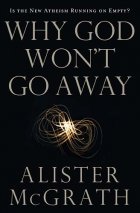
Review of Why God Won't Go Away: Is New Atheism Running on Empty? by Alister McGrath

Standard

Genre: Spiritual Growth/Academic Theology

Recommended.

Why God Won’t Go Away is a great introduction to New Atheism, how it was started, and what these particular Atheists believe. (There are several groupings of Atheists just as there are many sects of Christians and this book focuses specifically on New Atheism.) It is not too thorough—as I said, it’s a great introduction—but this would be an excellent resource for the Christian who wants to understand the basics. It is clearly written, logically presented, offers many interesting and philosophical ideas for further thought, and has an exceptional list of both Christian and Atheist materials throughout the footnotes and Further Reading section. I would premise that this is not really a debate or even reply to New Atheism, rather, a critical view of their position and mission intended for the Christian audience (or any person looking into New Atheism from an outside perspective).

McGrath is a former Atheist, now Christian, who currently engages in public debates with prominent Atheists as well as being renowned for his scholarly theological work. I was particularly impressed with McGrath’s kind and humble acknowledgement of the Atheist intellectuals despite his disagreement with their thoughts and pronouncements. I felt he was fair and rational in his critique and opinion that New Atheism is in decline. I look forward to reading his other books!

I received a complimentary copy of this book as a part of the Thomas Nelson Book Review Blogging Program through booksneeze.com.

Review of Is the Bible Reliable? by Focus on the Family

Standard

Genre: Multimedia/Apologetics

Series: True U

Highly Recommended!

Is the Bible Reliable? is a ten part DVD curriculum building the case for the reliability of the Bible as a historical document. It is the second in the line of Focus on the Family’s True U series, which take the viewer into the university classroom to explore various aspects of the biblical worldview.

These DVDs look specifically at whether archeological, historical, and anthropological evidence correspond with the events, persons, and places described in the Bible. The first six lessons look at the Old Testament: the documentary hypothesis, the validity of the Israelites as a distinctive people group that left Egypt for Canaan and took military conquest of the inhabitants of that land, the kingdoms of David and Solomon, and the Babylonian conquest of Judah. The next four sessions focused on the New Testament: the transmission of the Bible, evidence for the early composition of the synoptic gospels and Acts, and the significant corroboration of external evidence to the biblical account.

I was impressed with the amount of solid discussion in each 30 minute episode. This series offers a great jumping off point for further research and discussion into the historical aspects of the Bible. It was also well presented and easy to follow. I think it would be a great resource for an academically focused small group or college group, and would probably even benefit younger teens (depending on their interest and aptitude).

This set comes with two DVDs of ten 30 minute sessions and a discussion guide. The discussion guide has a fill-in-the-blank activity and a matching activity for every section to help solidify the main points, and has various blurbs and comics as well. If I was leading a small group of this study, I would try to get everyone their own discussion book.

I received a complimentary copy of this product as a part of the Tyndale Blog Network.

The Prodigal Son (Luke 15:11-32) Part Three: The Father

Standard
A man had two sons. The younger of them said to his father, 'Father give me the share of the estate that falls to me.' So he divided his wealth between them. And not many days later, the younger son gathered everything together and went on a journey into a distant country, and there he squandered his estate with loose living. Now when he had spent everything, a severe famine occurred in that country, and he began to be impoverished. So he went and hired himself out to one of the citizens of that country, and he sent him into his fields to feed swine. And he would have gladly filled his stomach with the pods that the swine were eating, and no one was giving anything to him. But when he came to his senses, he said, 'How many of my father's hired men have more than enough bread, but I am dying here with hunger! I will get up and go to my father, and will say to him, 'Father, I have sinned against heaven and in your sight; I am no longer worthy to be called your son; make me as one of your hired men.' So he got up and came to his father. But while he was still a long way off, his father saw him and felt compassion for him, and ran and embraced him and kissed him. And the son said to him, 'Father, I have sinned against heaven and in your sight; I am no longer worthy to be called your son.' But the father said to his slaves, 'Quickly bring out the best robe and put it on him, and put a ring on his hand and sandals on his feet; and bring the fattened calf, kill it, and let us eat and celebrate; for this son of mine was dead and has come to life again; he was lost and has been found.' And they began to celebrate.
Now his older son was in the field, and when he came and approached the house, he heard music and dancing. And he summoned one of the servants and began inquiring what these things could be. And he said to him, 'Your brother has come, and your father has killed the fattened calf because he has received him back safe and sound.' But he became angry and was not willing to go in; and his father came out and began pleading with him. But he answered and said to his father, 'Look! For so many years I have been serving you and I have never neglected a command of yours; and yet you have never given me a young goat, so that I might celebrate with my friends; but when this son of yours came, who has devoured your wealth with prostitutes, you killed the fattened calf for him.' And he said to him, 'Son you have always been with me, and all that is mine is yours. But we had to celebrate and rejoice, for this brother of yours was dead and has begun to live, and was lost and has been found.'
There is a Jewish tradition that the first character introduced in the story is the one the story is about, and so the father is actually the story's primary focus. Here we have the father of two disobedient sons, and yet he loves them both, is generous to them both, and desires that both would be successful and prosperous leaders in his household.

We see that right from the start that the father divided his wealth between his sons. Whether or not it was appropriate for the younger son to ask for his inheritance, the father chose to readily give it to him. The father also chooses to give an inheritance to the older son—even though he neglected to receive it. And within all of this, there is no indication that there is a limit to the father’s resources.  He gives the younger son his inheritance, and yet, when the son turns back to his father in repentance, the father lavishes him all the more; it seems there is no limit to his generosity.

The father is also a good and generous master to his servants. His servants have “more than enough bread” and the indication is that he is so good to work for that the younger son would rather face his father under the worst conditions than continue working as a paid servant for another.

But the story reveals that the father is also generous with his love, joy and mercy.  In fact, he approaches both his sons.  He sees the younger son from a distance when he is still far off, which would indicate he has been waiting and hoping for that son to come home; and when he does come, the father runs over to embrace and kiss him. He doesn’t even wait until the son is back in the land—he goes out to find his son while the son is far off and heading in the right direction. He likewise goes out to meet his older son, and pleads for him to come in and join them in the celebration. The father’s character is to bring in his sons and celebrate with them. He is actively pursuing them both whether or not they realize it.

God is full of blessings for everyone—there are struggles too, but even within the struggles there are blessings. He wants everyone to join his party. And the party takes place in His Kingdom. There are festivities in other lands, but when they are done there is no lasting peace or excitement. The younger son was curious about the festivities in other lands, but they did not fulfill him. The prostitutes only excited him for a moment. The festivities could only continue until his money ran out. And before he knew it, he wasn’t having fun at all. God’s parties are not like this. They last forever and go from glory to glory—better and better each time. We have the anticipation of a huge event—a wedding, so to speak—where God will become married or united with humankind in a superb way; a collision of the spiritual and physical realms in a fulness not yet experienced. A time when evil will be driven from the earth and the earth itself will be transformed. This will be very exciting!

But there’s something cool happening right now as well. Even now, God’s Kingdom is available to everyone who wants to live with Him. He wants everyone to join in.

The Prodigal Son (Luke 15:25-32) Part Two: The Older Son

Standard
Now his older son was in the field, and when he came and approached the house, he heard music and dancing. And he summoned one of the servants and began inquiring what these things could be. And he said to him, 'Your brother has come, and your father has killed the fattened calf because he has received him back safe and sound.' But he became angry and was not willing to go in; and his father came out and began pleading with him. But he answered and said to his father, 'Look! For so many years I have been serving you and I have never neglected a command of yours; and yet you have never given me a young goat, so that I might celebrate with my friends; but when this son of yours came, who has devoured your wealth with prostitutes, you killed the fattened calf for him.' And he said to him, 'Son you have always been with me, and all that is mine is yours. But we had to celebrate and rejoice, for this brother of yours was dead and has begun to live, and was lost and has been found.'  (Luke 15:25-32)
The older son's problem is that he doesn't realize what it means for him to be a son. He is out in the field working (like one of the hired servants), rather than being at the center of the action in his father's house. As a result, he misses out on the best of his father's celebrations, resources, and attention; in fact, he doesn't seem to have much of a relationship with his father at all. Even some of the hired servants know more of what's going on in his household than he does! He doesn't know about the party until he approaches the house and hears the music because, although he lives under his father's rooftop, he's not spending his time in the household. Then, when he hears the music and dancing, he refuses to go into the party, despite the pleading of his father.

He is upset because he has been working so hard to earn his father’s attention, love, and generosity. And his feelings have grown into a jealousy of his brother, and have even caused him to be offended with his father. He thinks that because he has followed his father’s commands, his father owes him blessing. But his father responds from an entirely different perspective. He had already made his wealth available to both sons (Luke 15:12), and had considered the resources of his household to belong as much to his oldest son as it did to himself (Luke 15:31). The father wanted more than just obedience—he wanted a relationship with his son, to celebrate over his son’s successes, and to be a physical part of his son’s life.

It’s unfortunate that the elder son has wasted so much time striving to get his father’s attention and affection when he had it all along and could have been enjoying life with his father. It’s even more unfortunate that he is spending so much energy being critical and jealous of his brother that he can’t loosen up to enjoy a good party with his whole family. He seems to have a serious adversion to having fun—maybe because he feels he doesn’t deserve it, or because he sees there is so much work to do—whatever the case, he’s the one choosing not to engage. It’s too bad because his father is all about fun. This is a big party: a feast with music and dancing!

We can learn a lot from the older son:

  • Are we, Christians, offended or caught up in our brothers (and sisters) business in a way that is preventing us from enjoying our own relationship with God our Father?
  • Might we be so focused on doing things for God that we miss out on celebrating in His presence?
  • Have we created so many rules for our faith that we are repulsed by any sort of celebrating--even if it's God's own party?
  • Do we know how to have fun and party with God or would we rather busy ourselves with work in the field?
  • Are we more often overwhelmed with offense, jealousy and skepticism or joy, love, and peace?
  • Do we recognize that God is loving, forgiving, joyful and fun-loving, or do we feel He is angry, disapproving and solemn toward us?
God wants His children to be able to enjoy Him. That's what this thing is about: He created humanity because He wanted a bigger family to love and enjoy. Even after we have rejected Him, He still desires us. That's why God came as a man--as Jesus, His son, the physical representation of the invisible God. He came to reconcile the people of the world to Himself--to invite us to join His Kingdom as His sons and daughters the way He had intended all along. When He comes a second time, He will be taking His love a step further by reconciling the whole physical world to Himself as well. He has done so much for us! Let's forgive our brothers, be reconciled to God and join the party!

The Prodigal Son (Luke 15:11-24) Part One: The Younger Son

Standard
A man had two sons. The younger of them said to his father, 'Father give me the share of the estate that falls to me.' So he divided his wealth between them. And not many days later, the younger son gathered everything together and went on a journey into a distant country, and there he squandered his estate with loose living. Now when he had spent everything, a severe famine occurred in that country, and he began to be impoverished. So he went and hired himself out to one of the citizens of that country, and he sent him into his fields to feed swine. And he would have gladly filled his stomach with the pods that the swine were eating, and no one was giving anything to him. But when he came to his senses, he said, 'How many of my father's hired men have more than enough bread, but I am dying here with hunger! I will get up and go to my father, and will say to him, 'Father, I have sinned against heaven and in your sight; I am no longer worthy to be called your son.' But the father said to his slaves, 'Quickly bring out the best robe and put it on him, and put a ring on his hand and sandals on his feet; and bring the fattened calf, kill it, and let us eat and celebrate; for this son of mine was dead and has come to life again; he was lost and has been found.' And they began to celebrate.  (Luke 15:11-24)
The younger son asks for and receives a portion of his inheritance, and soon runs into problems. The problem, though, is not that he asked for his inheritance, but that soon after getting it he forsakes his father's household and values for a distant land. Once in that land, he squanders his inheritance and neglects to be alert to the economy. In fact, it is after spending everything that a famine occurs in the land, but he had not had insight into the economic season and had acted irresponsibly with his possessions.

When the famine hits, the younger son comes into bondage to the land. Whereas before he may have been just a visitor spending money and enjoying life, he is now forced to work for the citizens of that country. Even worse, he has to tend to pigs, which by his (Jewish) tradition was unclean work. He felt that he had no choice but to be bound in service in this land and at this job—hungry and unfed. But there is always a choice.

He realizes that he can still return to his father’s house—as a slave. He goes home and apologizes to his father. But instead of taking him in as a slave, the father rejoices over his son and redresses him as a member of his household. The younger son is now honored in the position it seems his father wanted him in all along.

God is our Father and wants us to take an active part in His Kingdom. He wants to bless us with our inheritance (spiritually, physically, even materially), and sometimes He does. Other times He protects us by not giving us the things we want when He knows it would only be a stumbling block to the greater gifts of faith. When God does choose to bless us in physical and in material ways, it is important that we remain in His Kingdom so that we do not squander our wealth or faith. Only in the Kingdom do we have wisdom through the Holy Spirit from God as to how to best live now despite the unknowns of the future. It becomes very difficult and painful to leave the “distant lands” outside of God’s Kingdom once we engage in pleasure from them. And of course, there is deep benefit in learning to be the sons and daughters that God is inviting us to be. God loves us with a deep love, as a father, and wants us to partner with Him—not as mere slaves (regardless of our past sins)—rather, He wants to clothe us in royal garments and delights in letting us rule with Him, with full access to the resources of His Kingdom, our home!

The 'Good News' without Supernatural Power is NOT Good News

Standard

I was reading this morning an account from a friend’s friend who has left the church after 20 years of serving in ministry and is near leaving his Christian faith. He spoke sincerely and vulnerably regarding the process of his deconversion from Chaplain to agnostic. His reasons for change are: 1) inside knowledge of the awful condition of local church, 2) no clear examples in his life of pure, supernatural moves of God that couldn’t in some way be explained in humanist terms—that is, nothing separating what a Christian can do from what the non-Christian can do, 3) too many clear examples of wickedness being done in the name of Christ, and 4) the hypocrisy and fear-based/brain-washed commitment of the Christians around him. I really enjoyed his perspective so I hope I am relaying this accurately.

It’s my opinion that the large majority of Christians (in the States) are not practicing Christianity. I have seen first hand the sort of situation this man describes: the structure of religion and the academic declarations of theology (as good as this can be) without the supernatural power of a living and loving God (not to mention the rest of it..). But didn’t Paul the Apostle say, “my message and my preaching were not in persuasive words of wisdom, but in demonstration of the Spirit in power, so that your faith would not rest on the wisdom of men, but on the power of God” (1 Cor 2:4-5)? And isn’t the New Testament full of supernatural accounts done by the Spirit through Jesus’ followers?! God has not changed (Mal 3:6, Heb 13:8). The purpose of the believer on the earth hasn’t changed—we are still strengthening the ‘bride’ and collecting the harvest until the day of our Lord’s return. Jesus is alive, and so is His Spirit!

When Jesus died on the cross, He paid the sacrifice of our sins once and for all. Every hurt, every pain, every struggle; everything that’s been done to you, and everything you’ve done that has brought destruction to yourself or someone else—it died with Jesus on the cross. He was resurrected, and the sin wasn’t; the bondage of sin has been taken care of. To become a Christian means to surrender to God and accept the free gift of perfect freedom, love, joy, peace, and so forth. He already bought the gift of freedom—for the whole world. It’s an acceptance of that gift to the point of full re-birth. People don’t go to Hell because they don’t believe in God, but because they’ve rejected Him. Everyone at some point has the choice to accept or reject Him; it’s a serious decision. When we choose Him we get to walk out of the bondage and straight into the Kingdom. Don’t you know, the Kingdom is at hand!?! And in the Kingdom are miracles galore! We are new creations, equipped with supernatural gifts. We do heal the sick and cast out demons and prophesy and do miracles, just as His first disciples did. We love God to such an extent that we can’t help show His love in demonstrations to everyone we meet. Heaven is a party and it starts now! And that’s GOOD NEWS! When Jesus returns to be King the party is only going to get bigger! YAY!!

There was a moment in my life (quite a ways after my decision to be saved, repentance, and water baptism) where God in His supernatural power and grace, immersed me with His Spirit and, in a moment, re-birthed me into perfect freedom. None of my old self was there. I became completely new. My thoughts changed, my moods changed, I stopped taking medication for my various psychological disorders because they were gone, I didn’t have to pretend to be happy because I really truly was (to an even greater extent today!), even many of my interests changed! I cannot describe the peace that’s in my spirit. Fear is gone!

If you haven’t experienced this level of joy, and peace—whether you’ve been a Christian for years or if you identify with a different religion all together—I want to say a short prayer for you:

May you encounter the very presence and being of God Himself through Jesus Christ the Lord, the people who live in His Kingdom, and the mighty restoration of the grace of His salvation!

Is God Good? (Part Three: Why Did God Make Pharaoh's Heart Hard?)

Standard

Be sure to also read Part One and Part Two of this series.

God hardened Pharaoh’s heart to demonstrate His Glory among Egypt and Israel and the earth so that the people would know He is God.  But Pharaoh wasn’t chosen as a tragic casualty so that his people would see God’s power; there is more to the story.

The Biblical account in Exodus 3-15 shows us that Pharaoh wasn’t pursuing to know the Hebrew God, and in fact was consumed with his own gods and his own ways.  In other words, he was already hardening his own heart to God, God just allowed for this to happen more quickly.  We also see that God has full knowledge of Pharaoh’s thoughts and intentions, and is making a good and righteous judgment by hardening Pharaoh’s heart.

This is a pretty long account, so I’m going to highlight just a few areas; I’d encourage those who are interested in this story to read and dialog with God about it more thoroughly.

  1. Ex 3: 19: God is giving Moses instructions on how to present his case to Pharaoh and says He knows that king of Egypt will not permit the Hebrews to leave except under compulsion (or 'unless a mighty hand compels him').
  2. Ex 7:3: God will harden Pharaoh's heart that He may put on a bigger show--that He may multiply the signs and wonders in the land.
  3. Ex 7:22: Pharaoh's heart is hardened because he sees that his own magicians can do the same 'magic' as the Lord--he doesn't care to know God, but to have power, and he isn't impressed by God's power so long as his magicians can imitate it.  If he were to seek the Lord, it would be for the wrong intentions: to have more power and control.
  4. Ex 8:15: here Pharaoh hardens his own heart and it is clear his desire was for relief from the plague rather than an awe at the power of God.
  5. Ex 8:18-19: even when his magicians cannot imitate God's power and admit to Pharaoh that "This is the finger of God" he does not listen.  He really doesn't want to know God.
  6. Ex 9:16: God could have just killed Egypt to free the Jews.  He went about freeing them in this creative way so that His power and name would be proclaimed in ALL the earth.  He may have picked the Jews, but He's always wanted everyone to know of Him and be His people.
  7. Ex 9:34: at some moments Pharaoh hardens his own heart...
  8. Ex 11:9-10: other times, God hardens Pharaoh's heart, giving Him the chance to do even more miracles.
God is very much about free will (letting us make our own choices).  As a result, He will help us get wherever we want to go faster.  If we earnestly desire Him, we will find Him.  If we want to engage our own desires and run our own lives, He will let us do that too--in some cases speeding up the process of hardening our hearts so that the 'smashing of the clay' can be done sooner than later, or so that we can be a demonstration of His might.

So, when God hardened Pharaoh’s heart, it wasn’t a violation of Pharaoh’s will, but a hastening of the choice Pharaoh had already made.  It also provided for Pharaoh to have a final season of mercy as God did extravagant signs and wonders right before his eyes—signs and wonders that also gave the Israelites confidence and awe in their God, and allowed for the name of the Lord to be known throughout the nations (Ex 15:1-3, Ex 15:14-16).

The Turning Point: Jeremiah, the potter, and the clay

Standard

The word of the Lord spoke to Jeremiah and led him to a potter’s house where the potter was working clay into a vessel.  The Lord uses this physical demonstration to show Jeremiah how, like the potter, He wants to mold us into beautiful vessels, but sometimes we (the clay) aren’t malleable in His hands.  (Jer 18)

With each piece of clay there’s a turning point where the clay just can’t be reworked any longer.  The clay is so stubborn that it becomes hard and the potter can’t physically mold it.  This clay becomes a ‘vessel of wrath’ and is thrown into the valley where it shatters into pieces.  (Jer 19)

It is always God’s intention to make beautiful vessels. When we don’t listen to His purposes or incline our hearts to know His ways, we become spoiled in His hands—He can remold us again and again, but there is always a point where we, like the clay, can’t be reworked.  It isn’t God’s fault when we don’t cooperate, it’s ours; just as the potter wanted to make lovely vessels but couldn’t if the clay wouldn’t cooperate.

God’s exhortation to Jeremiah through the physical demonstration of the clay is to warn the people to turn away from evil, and to reform their ways and their deeds (Jer 18:11).  He wants them to turn back to Him so adamantly that He is willing to use severe measures to get their attention that perhaps they will be shaken by the extremity of what their stubbornness is doing to them.

There is a physical choice, in other words, to soften our hearts to the Lord (the circumcision of the heart) and be malleable in His hands.  This requires complete surrender (submissiveness) on our part, but allows that we would be created into a beautiful vessel of the Lord—and once we understand that He is good as He says He is, we can trust that whatever He wants to make us into really is the most fulfilling thing.

Is God Good? (Part Two: The Flood)

Standard

Be sure to also read: Is God Good? (Part One).

In the Old Testament there were times when God killed nations of people at once—even all but eight people in the day of Noah and the flood—but He was still good.

The Lord gave me a metaphor to describe the steadfastness of His love and goodness within the destruction of the flood.  He asked me:

If you had a farm and all the animals caught a really painful, harmful disease that was definitely incurable what would you do?  Surely, you wouldn't want them to have to go on living like that and to have babies who would also live tragically painful lives.  So, wouldn’t it be more merciful for you to kill (as quickly and painlessly as possible) the infected animals before they got worse, multiplied, and infected others on the farm?
God's goodness means He is concerned not just with the here-and-now of our lives, but with the eternal--with the whole big picture.

Something had happened in the days of Noah which caused God to take action by destroying life on the earth: there was ungodly sexuality, violence, and evil reigned continually in the hearts and thoughts of men (Gen 6).  In fact, it’s so bad that God not only kills the large majority of the earth, but lowers the lifespan to 120 years so that future generations would have less time to cultivate evil (Gen 6:3).

The people were so corrupt that God in His infinite knowledge knew there was no hope for them turning to Him without His violating free will, which He chooses not to do; their hatred was too deep.  They were infected with the disease of wickedness, because they choose to cultivate the wickedness of their hearts.  In order that they would not multiply and produce more kids (who would be raised in wickedness and endure eternal punishment), and so they would not create for themselves even more sin (which would ensue even more judgment), God, being full of mercy and justice, chose to kill them.

This wasn’t God’s ‘plan’—He never delights in killing anyone.  Scripture says that He was “sorry” and “grieved in His heart” by man’s actions (Gen 6:6-7).  These aren’t the emotions of an uncaring God, but of one who is so intimately involved with His creations that their apostasy deeply saddens Him.

It made God sad that the people would choose wickedness over Him, but He could not let them dictate and infect the decisions of future generation, nor could He let them continue to destroy themselves in their wickedness.  So it was in His goodness and perfect love that God destroyed and cleansed the earth with water, saving only Noah, his family, and the animals that were left with them in the ark.

Is God Good? (Part One)

Standard

I’ve met so many people—both Christians and not—who struggle to believe in, connect with, or admire God because it’s hard for them to see Him as ‘good’; so this is post one in a series on God’s goodness.

I want to begin by showing that the Bible testifies that He is good.  In later posts I will focus specifically on how we can see God’s goodness within the Bible stories that seem mostly negative (and perhaps this can move into discussion of how God is working in our day-to-day lives).  If a specific Bible account has particularly bothered you or a friend in terms of God’s goodness, please comment about it below and perhaps I will address it specifically.

Here is one of my favorite psalms in which David testifies of the Lord’s goodness:

Men shall speak of the power of Your awesome acts / And I will tell of Your greatness. / They shall eagerly utter the memory of Your abundant goodness / And will shout joyfully of Your righteousness.

The Lord is gracious and merciful; / Slow to anger and great in lovingkindness. / The Lord is good to all, / And His mercies are over all His works. / All Your works shall give thanks to You, O Lord, / And Your godly ones shall bless You. / They shall speak of the glory of Your kingdom / And talk of Your power; / To make known to the sons of men Your mighty acts / And the glory of the majesty of Your kingdom. / Your kingdom is an everlasting kingdom, / And Your dominion endures throughout all generations.

The Lord sustains all who fall / And raises up all who are bowed down. / The eyes of all look to You, / And You give them their food in due time. / You open Your hand / And satisfy the desire of every living thing.

The Lord is righteous in all His ways / And kind in all His deeds. / The Lord is near to all who call upon Him. / To all who call upon Him in truth. / He will fulfill the desire of those who fear Him; / He will also hear their cry and will save them. / The Lord keeps all who love Him. / But all the wicked He will destroy. / My mouth will speak the praise of the Lord, / And all flesh will bless His holy name forever and ever.  (Psalm 145:6-21)

I love David’s account here of God’s character.  If God is who David says He is, than He’s not just good but abundantly good in a way we can physically remember!  He’s not just righteous, but righteous in a way that will cause us to shout for joy if we truly experience it!  He is enough to satisfy every living thing, near to all who call on Him in truth, and protecting all who love Him.  Perhaps what catches me the most is that He is “good to all”, which means that even as He is destroying the wicked He is good!  This can be a bit mind-boggling, so is worth breaking down.  We will spend many more posts on this (though perhaps not consecutively—especially as I am currently out-of-state visiting family). :)